
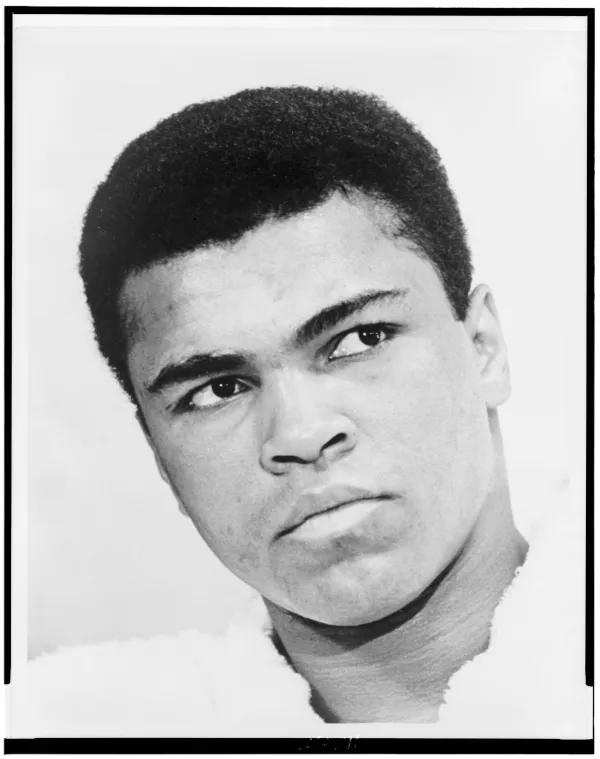
Ten years ago, friend Willis E. Brown, and my two young sons piled into my van in the early morning hours of Friday, June 10, 2016, and set out for Louisville, Kentucky, the birthplace of Muhammad Ali. Two hours later we stopped in Cincinnati and picked up my former student, Kevin L. Brooks, PhD, who was there visiting friends and family. The weather cooperated making for a rather uneventful trip.
We traded stories of our favorite memories of Ali. The purpose of the road trip was to say goodbye not to the self-proclaimed greatest boxer of all time whose funeral was being held that day but to say farewell to the most influential athlete of the 20th century and one of the world’s most iconic personalities and meaningful political figures. In the days following Ali’s death on June 3, I showed my sons videos of Ali’s fights, but even more importantly I exposed them to the story of Ali’s stance during the Vietnam War, one that cost him his heavyweight championship belt, boxing license and placed him in the crosshairs of the United States government. Forty-five years since his last fight (against Trevor Berbick) and ten years after his death Muhammad Ali remains a 1 of 1, the most influential athlete of the 20th century. It is for that reason I thought it important that my sons be present at Ali’s homegoing.
No athlete before Ali or since has demonstrated the level of courage and bravery that was seen in him. His refusal to be inducted into the United States armed forces cost him money, popularity (even among a sector of his own people) and the ability to ply his trade. Criticized heavily by the American media in the early 1960s for associating with the Honorable Minister Malcolm X and converting to Islam and changing his name there was a period when Ali was a pariah in the eyes of some. He was even criticized for meeting with Dr. Martin Luther King, Jr. on March 29, 1967, who publicly supported Ali’s plan to refuse induction into the Army. Four weeks later, April 28, 1967, Ali, citing his religious beliefs refused induction in the U.S. armed forces understanding full well that by doing so he was risking his livelihood and his freedom. Some thought Ali’s stance was grounded in hubris, that he would cave eventually. They were wrong.
Retired Cleveland Browns fullback and the NFL’s all-time leading rusher at the time, Jim Brown, wanted to see for himself just how serious the young pugilist was about this whole thing. Brown along with numerous other athletes, basketball and football, held a close-door meeting with Ali on East 105th and Euclid Avenue in Cleveland on June 4, 1967. For hours the men drilled Ali with questions and evaluated the veracity of his public statements and so forth. Not everyone Brown tried to recruit was interested.
At the meeting was a young Lew Alcindor of UCLA, Boston Celtics center Bill Russell, Green Bay Packer defensive lineman Willie Davis, the Washington Redskins wideout and halfback Bobby Mitchell, and Cleveland Brown’s offensive lineman John Wooten. Even future mayor Carl Stokes was in attendance. Brown had been in the Army ROTC at Syracuse University while Wooten had completed his military obligation in 1960. By meeting’s end however Brown and Wooten were in support of Ali without reservation and qualification. The meeting was memorialized in a photo called The Summit.
Weeks after that meeting Ali was convicted of draft evasion on June 20, 1967, sentenced to five years in prison, fined $10,000 and banned from boxing. Hard times came yet he never wavered. On June 28, 1971, the U.S. Supreme Court overturned the conviction for evading the draft. However, prison or no prison Ali was firm in his decision and was prepared to do the time if it came to that. Whatever the penalty Ali didn’t care; he stood on principle. When reporters peppered him with questions he would famously blurt out, “I ain’t got no quarrel with those Vietcong . . . no Vietcong ever called me Nigger.”
Ali’s fight against the United States government should be to some extent understood within the context of the Black Power Movement, a period when Blacks, especially young Blacks were exhorting self-determination. This idea of Blacks being able to control their own destiny permeated many aspects of American life including but not limited to the world of professional and collegiate sports.
Ali proved to be an inspiration to a lot of sports figures. People like Curt Flood, an all-star outfielder for the St. Louis Cardinals who refused a trade following the 1969 season, ultimately appealing his case to the U.S. Supreme Court is one example. Although his case proved unsuccessful, it played a pivotal role in the advent of free agency in Major League Baseball. The same can be said for free agency in the NBA with Oscar Robertson and the NFL with Baltimore Colts tight end John Mackey. Then of course, there is the case of Spencer Haywood who changed college basketball forever via the landmark 1971 U.S. Supreme Court antitrust lawsuit, Haywood vs. the National Basketball Association which allowed players to leave college early to play professional basketball.
There was a time when Muhammad Ali was the most famous person in the world. Any list of the top 100 most influential North American athletes of the 20th century must start with Ali as Number 1, and it’s not even close.
Judson L. Jeffries, PhD, MPH, is Professor of African American and African Studies at the Ohio State University.